IT Staffing in india, RPO in india, Recruitment company in india, Recruitment consultancy in india, Staffing consultancy in india, Contract staffing in india, Training & Development in india, Hire Train & Deploy in india,Mainframe outsourcing, z linux
Mainframes are the computer that is typically known for their large size, high processing power and high level of reliability. Many large organizations use mainframe to carry out critical and important applications which require high volumes of data processing.
Organizations are becoming progressively dependent on mainframe technology to support their critical functions. It’s a known fact that, it’s very difficult to retain the required skilled IT talents to keep all the systems hardware up and running.
Hence,
many businesses find it difficult to keep mainframe running without risking
their businesses interruptions or being subject to high costs. Simultaneously,
there may be loss of internal skills to manage mainframe infrastructure.
So, this is where Mainframe managed services comes into picture. This is also one of the best solutions.
Managed mainframe service providers help with staffing needs and by providing resource either on-site or virtually to manage their mainframe environment.
Benefits with Managed mainframe services:
Capitalize on IT Expertise On Demand
Concentrate More on Strategic Business
Initiatives
Remain in Sync with Compliance and Security
Trends
Upgrade Disaster Recovery Planning
Round the clock assistance
Management flexibility
Why Maintec mainframe managed services?
At
Maintec the professionals have deep knowledge in all major mainframe software
configurations. Being in this industry for so long, Maintec has handled just
about every combination of products. Also, Maintec gives importance for
customer satisfaction.
A Large, high speed computer, particularly one supporting various
workstations or peripherals. The most prevalent current example is the IBM Z
mainframe. This is descended from the System 360/370/390/zSeries/System z.
There are lines of computers from Hitachi and Fujitsu that run operating
systems called MSP and VOS3, which were plagiarized from IBM’s MVS operating
system in the 1980s.
Where it is used?
Mainframe computer or Mainframes (informally alluded to as “large iron”) are computers utilized basically by huge associations for basic applications; mass information preparing, for example, registration, industry and customer measurements, undertaking asset arranging and exchange handling.
Why to use mainframe?
To perform large scale exchange handling (a great many exchanges for
every second).
Supports thousands of clients and application programs simultaneously
getting to numerous Resources.
Manage terabytes of data in databases
Handle extensive data transfer capacity correspondence
What is z system?
Z/OS is IBM’s latest operating system that can manage many multi-tenant
mainframe applications, each running in protected memory spaces and offering
varied performance goals. Mainframes with z/OS are commonly used to run extensive, complex,
mission-basic outstanding tasks at hand for substantial venture associations.
Which industries use Mainframes?
There are mainly six industries where mainframe is being used.
In banking, finance, health care, insurance, utilities, government, and
a multitude of other public and private enterprises, the mainframe computer
continues to be the foundation of modern business.
Benefits of using Mainframe
Reliability, availability, and
serviceability:
The reliability, availability, and serviceability (or “RAS”)
of a PC framework have dependably been significant factors in information
preparing. When we state that a specific PC framework “displays RAS
qualities,” we imply that its structure puts a high need on the framework
staying in administration consistently. In a perfect world, RAS is a focal plan
highlight of all parts of a PC framework, including the applications.
Security:
One of an association’s most important asset is its information:
Customer records, bookkeeping information, representative data, etc. This basic
information should be safely overseen and controlled, and, all the while, made
accessible to those clients approved to see it.
Scalability:
It has been said that the only constant is change. No place is that
announcement more valid than in the IT business. In business, positive outcomes
can regularly trigger a development in IT foundation to adapt to expanded
interest.
Proceeding with similarity Mainframe clients will in general have an
exceptionally expansive monetary interest in their applications and
information. A few applications have been created and refined over decades.
What’s new for IBM Z?
z14
The z14 family has another single-outline model, based on an
industry-standard structure factor. Alongside innovations like inescapable
encryption you can make a minimal effort, secure, cloud foundation and
recognize openings through confided in advanced encounters.
Why IBM z-Select the model
perfect for your business or server farm?
Encode all application information very still and in flight
Do you know how to code? If not, you might want to learn sooner rather than later. Here’s why.
Employers want candidates with computer skills
As per the McKinsey Global Institute, the time we spend utilizing innovation at work will increment by 50 percent by 2030. Mechanization, huge information, investigation, mechanical technology, and AI are for the most part changing how we perform work. That is the reason businesses are searching for applicants who have some innovative aptitudes —, for example, coding and other programming abilities — notwithstanding their center proficient aptitudes.
So why is this?
To begin with, numerous businesses need individuals who can use PCs regardless of whether there’s no current application for an undertaking. This might be the situation with information gathering and investigation, for instance. Both are considerably more effectively and immediately achieved when you computerize the procedure.
In the meantime, it’s regularly simpler to utilize or redo an application in the event that you know about coding languages. This is particularly essential when you comprehend that every association has its own particular procedures that don’t constantly relate with a standard variant of an application.
At long last, it’s simpler to convey your requirements to engineers and other programming creators in the event that you have a comprehension of programming. Since numerous organizations have their own frameworks or applications custom constructed, this can be a basic preferred standpoint.
What skills are in demand?
The most in-demand programming languages:
Mainframe system programming
Android
IOS (iPhone & iPad)
Python
DBA
Web Technologies languages
Oracle
SAP
Network Security & Monitoring,Testing
Apache Hadoop & Bigdata and more languages.
There are various ways you can learn to code. One of the best ways to do it is via an online course. Fortunately, there are many free courses where you can learn the basics and move on to more advanced coding — while getting feedback from your peers . Click and apply now Mainframe online Training
Learning how to code might take some time and effort, but it can have a big payoff for your career — and your income!
On one hand, our clients face changing controls and rivalry from new kinds of banks entering the market. Keeping up methods we are continually pushing ahead—conveying new applications, enhancing the client experience and quickly stretching out new usefulness to on the web and versatile channels.
Then again, we should keep up our clients’ center saving money frameworks with nonstop accessibility and perfect security. These COBOL-based frameworks have been around for quite a long time are as yet basic to bank activities.
The hole between these two universes is extending as COBOL software engineers are resigning, supplanted by another age of designers. In this manner, we chose to construct an extension—one that will keep the two universes in sync, even as the banks advance.
Simplifying layers of complexity
We’ve constantly kept up a multi-level cross breed engineering to associate front-end, appropriated frameworks with backend IBM z/OS stages, utilizing IBM’s Information Management System (IMS) programming. This enables us to fabricate new Java-based applications that can get to information and exchanges from center saving money frameworks.
Notwithstanding, this engineering can get quite perplexing, with an entire layer of pay rationale expected to intercede exchanges. This unpredictability backs us off as we convey new applications and administrations to showcase.
Our test was to disentangle the design. We required present day, reusable programming segments with movability crosswise over both appropriated and z/OS situations, however we likewise needed to secure our interest in existing business rationale.
A groundbreaking approach to mainframe modernization
The arrangement was to carry Java into the IMS creation situations. We worked with IBM to make a typical run time condition inside IMS, making Java and COBOL inter operable. Truth be told, we were the primary organization on the planet doing this and we produce around 180,000,000 IMS exchanges multi day. Presently this innovation is accessible to everybody.
We presently have a more straightforward design, with more tightly reconciliation between center managing an account frameworks and new, circulated applications. This gives us greater adaptability and makes improvement less demanding, so we can assist our clients take creative administrations with marketing quicker, from the web and portable applications to ATMs and past.
Sooner or later, our front-end designers won’t know whether they are calling Java administrations or IMS exchanges in light of the fact that everything will be gotten to in one steady way. Today, in excess of 80 percent of our absolute outstanding burden is Java-empowered. A Java-empowered IMS exchange may call Java programs running in the IMS Java JVM. Along these lines IMS exchanges can utilize the tremendous number of Java standard libraries and outsider programming items. It likewise enables us to code new business rationale utilized in the IMS exchange in Java rather than Cobol and to relocate Cobol projects to Java.
It’s a progressive procedure, and we’ll at last achieve 95 percent of the all out remaining task at hand being Java-empowered.
This blend of Java and COBOL in the IMS condition is a decent method to modernize the center applications on the centralized server well ordered. We’re conquering any hindrance among old and new, helping our clients utilize their current speculations to empower what’s next in managing an account.
IT personnel naturally have their fingers on the pulse of today’s innovations and one eye fixed on the future. As a result, each rising generation of systems administrators and application developers seems convinced that they know better than their forefathers and can remedy all kinds of issues with new tools and tricks. Unfortunately, this appetite for innovation can cause overzealous administrators to fix what isn’t broken and swap out systems and practices that are still delivering strong results.
Here are the salient points to be noted.
A Rock Solid Foundation
The first generation of IBM i may have been introduced before some of
today’s young guns were even born, but the platform remains as vital as ever.
It also enjoys a consistent reputation for high availability,
security, and disaster recovery capabilities. Regardless of what a firm’s
future IT ambitions look like, those traits will always be highly prized
attributes.
With strong fundamentals in place, the hassle and expense of downtime
can be a distant memory and companies can be more aggressive in their strategic
pursuits.
A Bridge to the Future
Whether or not the younger generation of IT professionals care to admit it, business technology is sequential in nature. Even so-called disruptive developments like cloud computing have clear roots in practices and principles that came before. With that said, learning an IT department’s past and present modes of operation are a worthwhile pursuit for any new hire.
At the same time, IBM i can
also facilitate smooth transitions in an era when the pace of innovation is
faster than ever. The robust platform can reliably support legacy programs
holding up back-end operations while leaving plenty of room for the ingenuity
of home-cooked applications to thrive.
Automation Is Your Friend
Going off that last point, workload automation is becoming all the more
valuable as IT environments grow more complex and distributed. When staffers
are confident that bread and butter operations are reliably humming around
the clock, they have more time and energy to push the envelope with strategic
pursuits that can unlock new business opportunities.
IBM i is Listening
Finally, IT young guns should know that IBM i is by no means a static platform. We need to understand
that we will have to honour emerging developments and new rules of
the game with new features and possibilities. So any lingering fears that tying
one’s fate to the OS could leave them behind the curve can and should be put to
bed.
Today’s economy centers around the idea of technologies being connected, the enabler of what many are calling digital transformation. With larger enterprises still relying on mainframes to serve as the foundation of their technology stack, many question how to power leading-edge processes that enable real-time customer experiences and great efficiencies, using what are often considered to be legacy technologies. What may surprise people is that the mainframe remains a powerful tool for driving digital transformation.
It all comes down to creating the connected mainframe.
A recent IDC study found that traditional perceptions of the mainframe being an outdated technology are inaccurate; respondents showed that the mainframe has the potential to play a central role in digital transformation. In fact, the study found that the general belief among industry practitioners is that the connected mainframe can serve as the foundation of an enterprise-wide expansion.
How the connected mainframe drives digital transformation
How can the connected mainframe drive digital transformation? To begin with, the mainframe can be a provider or a consumer in the API economy. With the right tools, the mainframe can produce applications to power mobility, modern web-based processes and more. It allows for a faster time to market due to the use of already-adopted technologies and for innovative app development for today’s demanding customers. The mainframe’s ability to handle DevOps ensures the timely release of reliable applications in order to keep up with the fast-paced API economy.
Additionally, mainframes can easily adapt to today’s big data demands by monitoring numerous processes from a single source. By partitioning the mainframe, users can create environments that rival today’s cloud and virtual machine spaces, while still working within their secure environments. The result is a trusted space for enterprises to collect and analyze their structured and non-structured data, allowing them to easily keep up with today’s industry demands.
Lastly, the connected mainframe allows enterprises to efficiently implement cognitive computing. With machine learning and AI technologies flooding the market, these technologies remain useless without the proper data to mine, analyze and identify patterns within. While a common trend is to abandon the mainframe for modern technologies to drive these changes, the mainframe can backend cognitive computing processes by building applications on top of its established data repository. This leads to a more defined AI environment that pulls from the full gamut of data across numerous channels, effectively removing the need to rebuild a database.
Why consider using your mainframe for digital transformation?
First and foremost, using the mainframe to drive digital transformation is cheaper. In fact, IDC’s study found that operating costs for mainframe technologies dropped 35% once the mainframe was integrated with modern solutions. These cost reductions came from licensing fees, staff management and even power and facilities costs – as well as the benefit of not having to pay for the implementation of and training on a new system.
By keeping the mainframe in the fold, enterprises also benefit from baseline familiarity with the systems that are currently handling their operations, as opposed to uprooting everything and starting from scratch. Instead, mainframe integration solutions can be implemented to power the mainframes with modern user interfaces, allowing IT teams to easily work and innovate within the new environments without extensive training.
Finally, mainframes offer stability, as they are the backbone of many enterprises. From their increased security – compared to cloud-based systems – as well as their ability to easily handle enterprise-wide data and assets, mainframe shouldn’t be viewed as older technology. Instead, they must be viewed as the stable foundation to drive future innovation. In short, the mainframe is here to stay
When it comes to the mainframe, we must remember that it is a critical component of the digital economy. As professionals, we must change our way of thinking of the mainframe as outdated and instead understand its ability to continue powering innovative business operations. If any mainframe-based enterprise is looking to cut costs, increase stability, and drive digital transformation, they should start by embracing what has powered them to this point and celebrate the legacy of the mainframe.
Today’s mainframe is well positioned to support ever-evolving digital business environments, however, one important piece of the puzzle can sometimes be overlooked—security. IT pioneers must stand up to specific fantasies about centralized computer security, go to build up the correct security act for the present computerized change. Would you be able to answer the accompanying inquiries certainly? How secure is my centralized server? OK know whether you had security vulnerabilities? Would we pass a consistence review?
The possibility that Mainframes are invulnerable depends generally on legend and urban legend. Truth be told, centralized computers can conceivably make alluring prey for programmers and those with a noxious goal on the grounds that:
Mainframes have IP delivers and are presented to exemplary digital dangers
Undertakings frequently don’t know they have been hacked in light of the fact that they are not getting ongoing notices
Programmers are truly adept at covering their tracks and their essence can go undetected for a considerable length of time
Stolen passwords give simple access to your most business-basic information
Shielding against programmers infusing malware is amazingly troublesome
There are numerous fantasies about centralized computer security, however truly, strong, demonstrated systems exist to anchor your centralized computer. I trust the accompanying encourages you to isolate reality from fiction
Legends – Mainframes Are Not Hackable and Are Not at Risk
Mainframes here and there tumble off big business security radar and IT security experts think they are not at genuine hazard as a result of the inborn security incorporated with the frameworks, yet that is a deception.
IT multifaceted nature adds to the danger of security holes. The truth of the matter is we manage numerous IT universes and multi-faceted conditions with immeasurably unique working frameworks and projects. They talk diverse dialects, and less and less experts are conversant in every one of them. Since it takes roughly 200 days to distinguish a break, centralized server experts must be much increasingly watchful, even as it motivates more enthusiastically to do as such.
Information rupture. Two chilling words no security proficient needs to ever hear. Lamentably, centralized computer information may be among the most powerless, due to the touchy and alluring nature of the information. Consider stock exchanges fund or cash moves in assembling or government. The cash trails and IP delivers lead to centralized servers, so venture security stances must incorporate that stage. The chances of a future information break have expanded, and normal all out expenses have developed to about $4 million for each lost or stolen record. It isn’t just difficult to recuperate from money related misfortunes like that, it very well may be agonizingly hard to recoup from a discolored brand.
The Truth – The Mainframe is the Most Securable Platform
It is more imperative now than any time in recent memory to brace the basic business information that lives on your centralized server. With the correct devices, IT security experts can catch operational information and manufacture helpful 360-degree centralized server sees that alert progressively. You can distinguish and address for hazardous conditions and demonstrate consistence for both national and global security directions and consistence commands. Search for out-of-the-case capacities and review scorecards that assistance you meet prerequisites put forward by PCI DSS, HIPAA, GDPR and different measures.
Organizations need and need to anchor their information, however, accomplishing that objective can be grave for extended IT groups. Luckily, innovation and administrations have adapted to present circumstances. For the mainframe to stay suitable, it must be basic and clear for IT to keep up and improve imaginative innovation, that incorporates robotization, connection and security. At Maintec, we have found a way to help our centralized computer customers reinforce their security pose with our AMI for Security contributions and our implicit industry-driving centralized computer SIEM innovation.
Since you find out about diverting legends and connecting facts, you have the learning to expose centralized computer security fantasies and grasp the certainties with a develop security pose. It is basic for you to make the correct strides and plan for your venture wide security. Maintec is here to help. Find progressively about Maintec Automated Mainframe Intelligence (AMI) here. More details: Mainframe outsourcing
In spite of the fact that HCIs join figure, stockpiling and system assets into a solitary virtualized framework, they are not without wasteful aspects.
The “broadly useful” server farm models that have served so well in the past are achieving their points of confinement of versatility, execution and effectiveness, and utilize a uniform proportion of assets to address all register handling, stockpiling and system data transfer capacity prerequisites. The one size fits all’ approach is never again viable for information serious outstanding tasks at hand (for example enormous information, quick information, investigation, man-made brainpower and machine learning). What is required are capacities that empower more authority over the mix of assets that each need so that enhanced dimensions of handling, stockpiling and system transmission capacity can be scaled autonomous of each other. The end objective is an adaptable and composable framework.
Figure 1: Today’s data-centric architectures
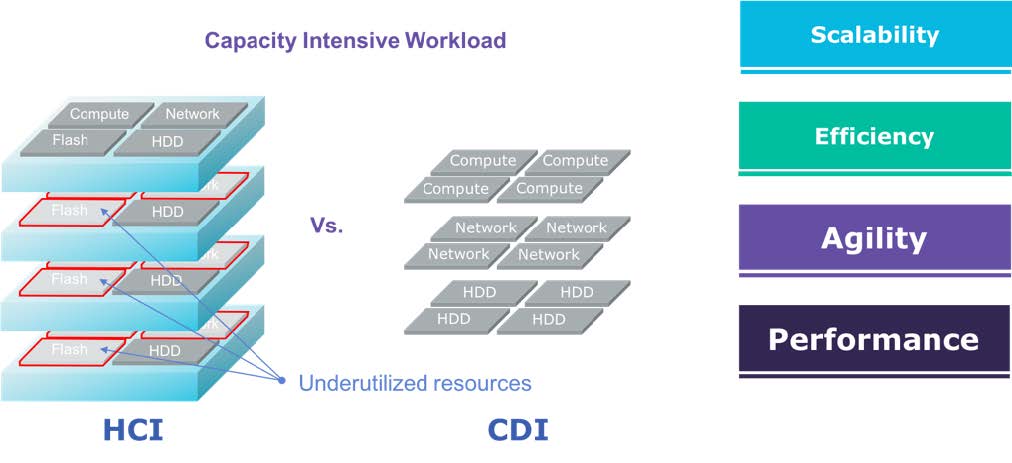
In spite of the fact that hyper-merged foundations (HCIs) join register, stockpiling and system assets into a solitary virtualized framework (Figure 1), to include more stockpiling, memory or systems administration, extra processors are required. This makes a settled building square methodology (each containing CPU, DRAM and storage)that can’t accomplish the dimension of adaptability and unsurprising execution required in the present server farms. In that capacity, Composable-Disaggregated Infrastructures (CDIs) are turning into a prominent arrangement as they go past joining or hyper-meeting IT infrastructure into a solitary coordinated unit, however streamlines them to enhance business readiness.
The Need for Composable-Disaggregated Infrastructures
Given the difficulties related with broadly useful structures (settled asset proportions, underutilization and overprovisioning), met foundations (CIs) rose conveying a preconfigured equipment assets in a solitary framework. The register, stockpiling and systems administration segments are discrete and overseen through programming. CIs have developed into HCIs where the majority of the equipment assets are virtualized, conveying programming characterized figuring, stockpiling and systems administration.
Despite the fact that HCIs join figure, stockpiling and system assets into a solitary virtualized framework, they are not without wasteful aspects. For instance, versatility limits are characterized by the processor, and access to assets are made through the processor. To include more assets, for example, stockpiling, memory, or systems administration, HCI designs gives extra processors regardless of whether they are not required to bring about server farm engineers endeavoring to construct adaptable frameworks yet are utilizing firm building squares.
From an ongoing study of more than 300 moderate sized and vast venture IT clients, just 45 percent of all out accessible capacity limit in an endeavor server farm framework has been provisioned, and just 45 percent of figure hours and capacity limit are used. The settled building square methodology exhibits underutilization and can’t accomplish the dimension of adaptability and unsurprising execution required in the present server farm. The disaggregated HCI show should be empowered and turn out to be effectively composable, of which, programming devices depends on an open application programming interface (API) is what’s to come.
A composable disaggregated foundation is a server farm structural system whose physical register, stockpiling and system texture assets are treated as administrations. The high-thickness figure, stockpiling and system racks use programming to make a virtual application condition that gives whatever assets the application needs continuously to accomplish the ideal execution required to meet the remaining task at hand requests. It is a rising server farm section with a complete market CAGR of 58.2 percent (determined from 2017 to 2022).
Figure 2: Hyper-Converged vs. Composable
On this foundation (Figure 2), virtual servers are made out of free asset pools included process, stockpiling and system gadgets, as opposed to parceled assets that are designed as HCI servers. In this manner, the servers can be provisioned and re-provisioned as required, under programming control, to suit the requests of specific remaining tasks at hand as the product and equipment segments are firmly coordinated. With an API on the creating programming, an application could ask for whatever assets are required, conveying constant server reconfigurations on-the-fly, without human mediation, and a stage toward oneself overseeing server farm.
Hyper-Converged versus Composable
An organized convention is similarly critical to a CDI empowering register and capacity assets to be disaggregated from the server and accessible to different applications. Associating figure or capacity hubs over a texture is vital as it empowers numerous ways to the asset. Developing as the leader organize a convention for CDI usage is NVMe™-over-Fabrics. It conveys the most reduced start to finish dormancy from application to capacity accessible and empowers CDIs to give the information territory advantages of direct-appended capacity (low in activity and elite), while conveying readiness and adaptability by sharing assets all through the endeavor.
Non Volatile Memory Express™ (NVMe) innovation is a streamlined, superior, low idleness interface that uses a design and set of conventions grew explicitly for industrious blaze memory advances. The standard has been stretched out past nearby joined server applications by giving a similar execution benefits over a system through the NVMe-over-Fabrics particular. This determination empowers streak gadgets to convey over systems, conveying a similar elite, low dormancy benefits as nearby appended NVMe, and there is for all intents and purposes no restriction to the quantity of servers that can share NVMe-over-Fabrics stockpiling or the quantity of capacity gadgets that can be shared.
Final Thoughts
Information serious applications in the center and at the edge have surpassed the abilities of customary frameworks and structures, particularly identifying with versatility, execution and productivity. As broader useful frameworks are bolstered by a uniform proportion of assets to address all registers, preparing, stockpiling and system transmission capacity necessities, they are never again viable for these assorted and information serious outstanding burdens. With the coming of CDIs, server farm engineers, cloud specialist organizations, frameworks integrator’s programming characterized capacity designers, and OEMs, would now be able to convey capacity and figure administrations with more noteworthy financial matters, dexterity, productivity and effortlessness at scale, while empowering dynamic SLAs crosswise over outstanding burdens.
Mainframe technology supplier BMC trusts that the technology
has a splendid future. BMC’s 2018 mainframe study, which surveyed 1,100
administrators and IT specialized experts, found that 92% respondents
anticipated long haul, stability of their mainframe systems – the third
sequential year this rate has expanded.
“Most associations have a lot of extensive, complex
applications integrated that, to be honest, the exertion required to just
revise so you can run it and work it in a cloud-only stage is exceptionally
cost restrictive, and amazingly risky,” said John McKenny, Vice President
of strategy for ZSolutions, at BMC, headquartered in Houston.
BMC does not have numerous clients moving outstanding tasks
at hand to the cloud, since they don’t see the long-term cost benefits, he
said. At the point when clients assess the expense of designing, architecting
and relocating that componentry of their architecture, “there’s just not
an economic benefit that holds water,” McKenny said.
Flaesch agreed that the regularly held thought that cloud is less expensive isn’t in every genuine case. “We have plenty of evidence of folks moving workloads back from the cloud,” he said.
There are distinctive parts of the mainframe market
to consider from a channel accomplice’s viewpoint: the systems software, the
application software, the staffing elements, the hardware and the hosting,
which are all “feeling different kinds of pressures,” Flaesch
said.
The best open door for partners is in client environments which have a significant arrangement of workloads and applications that should be stayed up with the latest as indicated by DXC. For instance, Flaesch said DXC has a transportation client that runs high demand forecasting and custom logistics applications. “So when it began … running its huge, cutting edge upkeep and IoT-driven support applications, doing that on a mainframe was a characteristic thing for them to do,” he said.
Flaesch trusts that the general agreement is that, mainframe technology is as yet the most savvy approach for running a substantial arrangement of remaining tasks at hand that should be collected. “[Mainframe systems] will be the most reliable and cost-effective, and it will give you the best service levels of any environment you can have, hands down,” he said.
The limitations to that would be when you don’t know how many workloads you’re going to be running, how fast they need to ramp up, and when IT is not certain about the type of applications it needs to develop and how portable they need to be, he added. For more details Mainframe Outsourcing
Here are three predictions for the mainframe industry in 2019.
1. The mainframe industry modernised – inside and out
In 2019, ventures will modernize both their centralized computer innovation and their workforce to meet the requests of our information driven period. That implies associations will organize application modernisation and grasp AI Ops and machine figuring out how to engage their evolving workforce.
Machine learning, examination, and savvy robotization will make ready for more associations to assemble self-overseeing centralized server situations that can anticipate and illuminate issues without manual intercession.
At last, centralized computer modernisation will likewise occur in the workforce – as an age of centralized server specialists resign, we will see a continuation of the pattern in which more twenty to thirty year olds are contracted to run propelled centralized server advances helped by the inherent area skill and robotization they have to succeed.
2. Mainframe, meet DevOps – when two worlds collide
There’s no such thing as a disconnected IT condition, particularly in a substantial undertaking. A significant part of the discussion around DevOps has fixated on cloud-based applications, however actually the present current application is frequently based on a multi-layered application engineering that ranges from portable to cloud to middleware to back-end exchange and information servers.
In this condition, the centralized server is the most amazing, most secure, most solid back-end processor and it must empower application groups to work in a multilayered improvement process. That requires devices for effect investigation, code audit and code the executives, also to make changes to the basic database rapidly and safely.
In 2019, associations will work to completely benefit from the deftness and speed that DevOps can bring, and with the correct methodology, centralized computers can be made an essential piece of the DevOps procedure. Expansive associations won’t have the capacity to completely benefit from this new arrangement display without interfacing their most imperative stages.
3. Mainframes will win over the C-Suite
Digitisation and portability are setting unbelievable weight on both IT and centralized computers to deal with a more prominent volume, assortment, and speed of exchanges and information.
Fortunately, the centralized computer’s life span stems halfway from its capacity to rethink itself continually to encourage the changing elements of current business, keep up close consistent accessibility and productively process billions of basic exchanges – turned out to be a practical long haul stage today.
As it keeps on filling in as the foundation of advanced situations, 2019 will be the year that clever IT tasks the board officials genuinely grasp the power and esteem their centralized computers convey to their business.





 Maintec