14 New Recruiting Trends You Should Implement in 2019

One of the biggest challenges that every business faces these days is filling a particular job with the right candidate. With advanced knowledge and expertise, candidates have become more selective about the companies they would want to work for. Therefore, businesses are struggling to recruit the right candidates for their organization due to this tight candidate driven job market.

You should have a unique approach while recruiting candidates for your firm. Well, 2018 is almost over, and the New Year is here. So, you should change your recruitment strategy with the latest trends. Here are 14 recruiting trends that you should implement in 2019 recruitment strategy.

1.     Use Technology for Talent Search

With the evolution of technology, you should also move from traditional talent search methods to a more modern and unconventional one. Using talent acquisition teams, your recruiters can be more systematic about how they spend their time interacting with candidates. Also, candidates, these days conduct their job search on a mobile device. According to a recent study, 45% of candidates use job recruiting apps to look for a job. But, many recruiters haven’t adopted this change yet.

2.     Recruitment Marketing

At first, you might be surprised to hear how marketing is associated with recruitment. Well, organizations have started making recruitment marketing strategies to attract talent to their organization. For many large enterprises, it has become an essential part of the recruitment process and considered as an excellent approach to choose the right fit. Recruitment consultancy in india

3.     Inbound Recruiting

Inbound Recruiting is a recruitment marketing strategy that allows recruiters to proactively and efficiently attract candidates with the goal to make them choose their company as their next employer. In inbound marketing, you can use different forms of media to attract, convert, and engage candidates.

4.     Employee Referrals

Employee referral program is one of the most effective ways to hire real talent and fill open positions. This method is cost-effective than other hiring techniques and allows companies to fill a position in the shortest time period. With the employee referral program, you not only get good talent, but your current employees also benefit from it.

5.     Employer Branding

By employer branding, we mean the reputation and popularity of a company as an employer, and what value it brings to its employees. According to a recent survey by LinkedIn, it has been found that around 75% of job seekers search for a company’s reputation and employer brand before applying for a job. So, employer branding is an essential factor in recruiting the right talent. You can improve employer branding by using Glass door and other social media platforms where candidates look for employer’s profile.

6.     Candidate User Experience

The overall perception of your company’s recruiting process in a candidate’s mind is known as candidate user experience. The way a candidate feel about your recruiting process from sourcing to screening plays a vital role in the hiring process. Candidates who have a positive candidate experience during your recruitment process are more likely to accept the job offer, reapply in the future, or refer others to your company.

On the other side, if candidates are not happy with your recruitment process, they will not take the job offer or might even leave the interview in between.

7.     Move on from Paper Resume

Well, this trend will take time to set down in the recruitment process. But, if we talk about candidate’s applications for a job, then the future is signaling towards digital resume. Organizations are paying more attention to soft skills than a paper document. Many recruitment companies check candidate’s social profile like LinkedIn before calling them for an interview.

It is not only beneficial for companies, but job seekers can also benefit by developing and integrating a strong social media profile to get noted by good recruiters.

8.     Internal Candidate Database

Internal candidate database is a process that allows organizations to create an inventory to keep job-seekers data. Many large organizations have implemented this strategy in their recruitment process because there is limited talent in the market. Also, when a job opening comes up, they don’t have to look for candidates on other resources. They can find the potential candidate in the internal candidate database to fill that position.

9.     Candidate Relationship Management

Candidate relationship management is a technique to manage and improve relationships with current and potential job seekers. It has become one of the top 2019 trends in the recruitment process. More than 70% candidate prefers to choose a company in which they have a better relationship with the recruiter.

10.          Develop an Attractive Online Profile

If you want to attract and hire top talent for your company, then you need to portray an appealing online profile for your organization. One of the best techniques to achieve this is using social media platforms, as they demonstrate a corporate culture of an organization. According to a research, more than 75% candidates review the social profile of a company before applying for a job. So, maintaining an attractive online profile has become a necessity for businesses.

11.          Recruitment Automation Tools

Artificial intelligence will make a huge impact on the recruitment process. In fact, it has already started making an impact in the UK job industry. Recruitment automation tools use artificial intelligence to automate recruiting process and help in finding, engaging, nurturing, and converting potential candidates into applications. They also simplify the recruitment process while making it faster and efficient.

12.        GDPR

Another latest recruitment trend that has come to light is GDPR (General Data Protection Regulation). It is a new law of EU legislation that replaced the current Data Protection Act. With GDPR, candidates can have more control over their personal information, which means it has completely changed the way recruitment process works.

13.        Data-Driven Recruiting

Data-Driven recruiting methods help HR departments to identify and evaluate a candidate for a position quickly. In Data-Driven Recruiting, the planning and decision making is based on data acquired through HR technology. It gives you insights on areas where you should focus and where you should improve your recruitment process.

14.        Structured Interviews

There have been many changes in the interview process previously, and it will keep going in 2019 as well. Organizations are moving towards a more structured interview process, which means recruiters use a standardized test to assess the candidate’s aptitude, personality talent, or physical suitability for the job. Some companies even prefer taking assignments to demonstrate the professional skills of the candidate for the required profile.

There are many benefits of structured interviews, such as objectiveness, effectiveness, legal defensibility, and fairness. Also, it is considered a better approach than traditional interviews.

Well, the trends will keep changing with time in the recruitment process. But, the most useful trends will always help companies to find the right candidate for their job opening. So, if you don’t want to lose any candidate that is suitable for the job opening or will be ideal in the future, then follow the 14 recruitment trends mentioned above.

More details visit: IT staffing in india

Next-generation IT infrastructure

The next generation of IT infrastructure promises to reduce costs and improve effectiveness. Yet implementation requires overcoming several significant challenges, from security to economics.

The pressure on IT infrastructure leaders is unrelenting. They must deliver higher service levels and new IT-enabled capabilities, help accelerate application delivery, and do so while managing costs. As standard IT improvements near a breaking point, it’s no wonder that many IT infrastructure leaders have started to look for more transformative options, including next-generation IT infrastructure (NGI)—a highly automated platform for the delivery of IT infrastructure services built on top of new and open technologies such as cloud computing. NGI promises leaner organizations that rely more on cloud-provider-level hardware and software efficiencies. In addition, NGI facilitates better support of new business needs opened up by big data, digital customer outreach, and mobile applications.

To understand how senior executives view NGI, we canvassed opinions from invitees to our semiannual Chief Infrastructure Technology Executive Roundtable. The results were revealing: executives expressed strong interest in all key NGI technologies, from open-source infrastructure-management environments to software-defined networking, software-as-a-service offerings, cloud orchestration and management, and application-configuration management. Yet most have not yet fully taken advantage of the promise of NGI, largely because of the up-front investment required. The immaturity and complexity of the technology is also slowing adoption, as is concern about the security of the public cloud, particularly with respect to companies’ loss of control in the event of private litigation or inquiries from governmental agencies.

For instance, executives in highly regulated industries such as health care and banking worry that public-cloud providers are not always well equipped to meet those industries’ unique regulatory requirements. As a result, they prefer to keep critical data within their own corporate firewalls. At the same time, executives recognize the potential security benefits of the public-cloud providers’ scale and operational expertise. Given their focus and size, public-cloud providers are more likely to have the expertise to combat security threats and prevent surreptitious breaches. The public cloud may gain greater acceptance if cybersecurity threats outpace the ability of smaller IT departments to combat them.

These considerations weigh on the objectives executives cited as priorities for their IT organization in the next one to three years (exhibit). Achieving all their goals—including generating more value from data, improving system security, and migrating legacy infrastructure to the cloud—requires “true program managers,” leaders who know how to work with internal and third-party sources to deliver an overall program rather than a discrete project. NGI involves deploying technological solutions across the full “stack,” from the data center to hardware to middleware and through the application layer, and often entails fundamental changes to the enterprise’s work flows and IT operating model. Make no mistake: IT infrastructure leaders are excited about the promises of NGI. But they’re equally clear-eyed about the challenges.

more details : IT infrastructure

A Short & Sweet Guide to Changing Careers

Picking a vocation is one of the hardest choices you’ll ever make—and like other essential choices, it’s difficult to fix once you’ve made it.

Be that as it may, in light of the fact that you’ve been working in an explicit job or field for quite a long time doesn’t mean change is unimaginable. Here are three interesting points when you’re pondering exchanging professions.

Am I doing this for the correct reasons?

When you’re hopeless at work, your mind will normally begin investigating different choices. You may end up fantasizing about expert streets not taken and taking a gander at employment postings for occupations that couldn’t be more not quite the same as your present one.

Be that as it may, your job probably won’t be the issue. What’s really making you troubled? Is your supervisor fantastically difficult? Is your compensation too low to even think about supporting your way of life? Is your remaining task at hand undemanding and unacceptable?

These are on the whole extraordinary motivations to leave your activity, however not your vocation. Before you begin pondering leaving your field, be straightforward with yourself about your inspiration.

Consider what makes you most joyful (and unhappiest) 

Make a rundown of the work obligations you appreciate the most, regardless of whether that is helping your immediate reports take in another ability, making inside and out reports for your administrator, or creating item dispatches, in addition to other things.

At that point make a rundown of the work duties you appreciate the minimum, for example, settling question between your colleagues, settling bugs, etc.

Next, compose a different rundown of the individual exercises you appreciate the most. Maybe you cherish training your niece’s hockey group or composing book surveys for your own site.

Last, take a gander at your rundowns and look for cover. Suppose you cherish instructing, regardless of whether you’re helping your colleagues or the hockey group. Or on the other hand you appreciate showing, regardless of whether you’re concocting movements for your organization’s representative withdraw or doodling for the sake of entertainment at home.

These patterns will manage you toward picking another vocation that satisfies you more.

Mellow the arrival 

Regardless, profession changes are hard. Fortunately, there are a few stages you can take that’ll expand the risks you get another activity.

To start with, converse with individuals in the business you need to change to. Ask which aptitudes they suggest you learn (or if nothing else begin to learn) before you change. Ask which organizations they’d prescribe you apply to (some are bound to consider non-customary hopefuls). Ask which associations they prescribe you join to construct your system.

The more you can set yourself up, the better. Utilize their data to distinguish classes, ventures, and individuals you can use to get a leg up before you leave your present job.

more details : Staffing consultancy in india

Information technology Staffing forms | Maintec Technology

The staffing business is one of the quickest developing ventures in the US and India. The US staffing industry is relied upon to develop at a rate of 6% in both 2013 and 2014, as indicated by the “US Staffing Industry Forecast: April Update.” The positive job of staffing firms in finding and enlisting hopefuls has effectively added to the proceeded with development of staffing organizations. Organizations consider staffing firms as an imperative device for finding the correct possibility for their empty positions. As indicated by the American Staffing Association (ASA), enrollment organizations offer the accompanying advantages to a business:

90% of organizations say that staffing organizations make adaptability and chance to keep a full staff amid pinnacle occupied seasons.

80% of staffing customers additionally say that staffing firms enable them to locate the correct hopefuls that can turn out to be full-time workers.

Since organizations recognize enlistment benefit is valuable to their organizations’ prosperity, the proceeded with development of this industry in 2014 isn’t an amazement; this is the fourth year of huge development of this industry post subsidence. staffing consultancy in india

IT staffing industry this year 

Examiners have just anticipated the development of the staffing business for the following year yet this year has additionally been a time of gigantic development for data innovation staffing firms. Staffing organizations saw a development rate of 4.1%, which is 2.4% higher than in a similar period in 2012. With the development in staffing organization’s obligations, it is vital to build the quantity of spotters also. The American Staffing Association demonstrates that there are 7.6% more staffing workers in October 2013 than there were in October 2012.

Notwithstanding the staffing business, the IT segment is additionally anticipated to see a hearty development of around 7 percent. This is probably going to build the interest for IT experts and make different occupation orders for IT staffing organizations.

Certain variables added to the ascent of business firms and furthermore supported their development. The most critical among them are:

Trouble in discovering IT laborers: 60 percent of organizations utilizing staffing arrangements concur that the essential explanation behind them to approach a work firm is to locate the correct IT contender for an empty position. Albeit consistently a huge number of specialized understudies finish their graduation program from various American colleges, it is hard to discover an applicant with the correct IT abilities and experience. Selecting an applicant inside a specific time allotment is much progressively troublesome.

Holding IT ability: Retaining IT experts is another extraordinary test for organizations today. Seven percent of organizations concur that they have issues in holding their best ability. Despite the fact that a worker’s pay is an imperative factor in his residency with an organization, there are different factors too that should be considered. For instance, if a worker does not fit in with an organization’s work culture or his partners it is hard to hold him, paying little heed to compensation.

Maintec that specializes in IT staffing in india. She has extensive knowledge and experience in all areas of human resource development and especially in the recruitment and retention of IT workers. For years IT companies have benefited by implementing her strategies and suggestions.

Why consider RPO from Maintec

Save Time

When choosing Maintec, you rely on a team of professionals with a deep understanding of the legal, fiduciary, and administrative nuances associated with managing payroll. This combined expertise ensures a streamlined and efficient process that optimizes your investment.

Contain Costs

When calculating the cost of resource allocation, compliance risks and effective use of employee skills associated with internal payroll administration and processing, outsourcing often provides a higher value that keeps costs contained.

Mitigate Risks

Penalties are not only costly but frequent, studies show that 30% of businesses are strapped with fines each year for payroll inaccuracies. Outsourcing payroll can reduce these risks by ensuring on-time and accurate reporting.

Cost
Clients using our RPO model have the freedom to measure their selected services to accomplish their talent requirements and targets. Our clients are able to apply their recruitment spend in a manner that eliminates high end fees due to unwanted operational costs. This helps increase consultant quality and thereby eliminates any cost associated with poor hiring decisions and turnovers.

Consultant
Maintec is able to commit and provide a positive consultant experience as we consider our clients’ branding as our own and become embedded to it. This is noticed extensively in our end-to-end recruitment cycle that involves sourcing, recruiting talent and interviewing. Our dedicated team of account managers and recruiters manage the complete recruitment life cycle; certifying that the high quality consultant influx is managed in the right manner to meet all manpower goals. 

more details : RPO in india

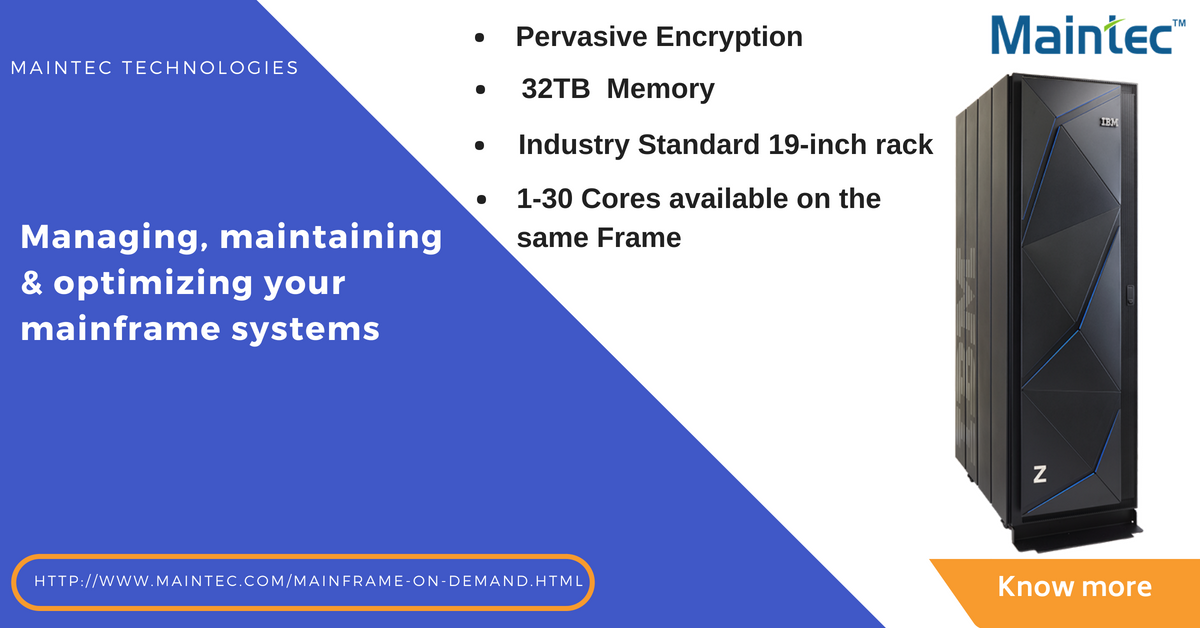
The Staying Power of Mainframes

In spite of the fact that an ongoing review about centralized computer use by state governments found that the registering workhorses are an imperiled species, a few clients and sellers aren’t as certain. The more probable situation is an IT domain that incorporates centralized computers, cloud and other on-prem stages.

“Centralized computers are staying put,” said Wisconsin CIO David Cagigal. That is on the grounds that the state, in the same way as other different associations in people in general and private divisions, needs to process billions of exchanges for each year on a safe, solid stage – two qualities of centralized servers.

Wisconsin has two centralized servers, one in Madison and a reinforcement in Milwaukee, that were conveyed in January as a feature of the state’s intend to cycle the frameworks out like clockwork. In any case, it additionally utilizes more up to date advancements: disseminated processing stages and Oracle Exadata for big business asset arranging exchanges, for example, fund, acquisition and HR.

The state additionally buys in to cloud administrations. For example, it’s about part of the way through moving email to Microsoft Office 365, and it’s receiving voice over IP in the cloud with 3,000 gadgets previously moved and another 35,000 to go.

“Our future, I believe, is shake strong on account of the mixed arrangement, or cross breed arrangement, that we have with different stages,” Cagigal said.

Choices to move applications off the centralized server have been founded on expense, Cagigal stated, yet those applications speak to a small amount of what the centralized computer handles – right now around 16 billion exchanges per year – and doesn’t require getting rid of it. Truth be told, he anticipated the centralized computer will turn out to be increasingly dug in after some time.

“On the off chance that you take a gander at Obamacare and the expanded requirement for electronic wellbeing records, it’s simply going to build the volume, thus in this way we turn out to be significantly more reliant on the centralized server,” he said. “It will develop naturally by the volume of exchanges yet won’t develop by the quantity of new applications.”

Furthermore, that is OK, he included, on the grounds that it’s taking care of enough handling each day for what it’s worth. “The present condition is a heritage domain. It has not changed that a lot throughout the years,” Cagigal said. “We truly haven’t built up another application on the centralized server and don’t envision doing that.”

All things considered, an ongoing report by the National Association of State Technology Directors found that 79 percent of respondents said they don’t see a future interest for centralized computer processing power. That can’t be valid, Cagigal stated, in light of the fact that the handling volume doesn’t leave. Rather, what he sees as almost certain is a move of proprietorship.

“At the point when individuals say that they’re being diminished, possibly the centralized servers are in the cloud, by a cloud supplier, yet despite everything someone has to possess a centralized server,” he said.

Sam Knutson, VP of item the board at Compuware, an organization whose bread and butter is centralized servers, said the stage might be 50 years of age, yet it’s a long way from obsolete on the grounds that makers, for example, IBM have reliably modernized their contributions. The outcome is single stage on which offices can run decades-old application code and more up to date programming dialects, for example, Java.

“Working code is gold,” Knutson said. “On the off chance that I’ve composed code more than 40 years, and it has the majority of the business procedures of my express, my organization, my organization, that is a huge venture I’ve made. If I somehow happened to take that code and revamp precisely the same business process in an alternate dialect in an alternate stage, I wouldn’t have made any an incentive for the native. It wouldn’t give any better administration.”

Furthermore, he stated, centralized computers and cloud are integral. For instance, organizations are better off utilizing Office 365 for email than facilitating their very own framework on a centralized server. On the off chance that they need to move exclusive applications off the centralized computer, they’d must will alter their procedures to what’s accessible.

Numerous organizations find that their current centralized server applications serve their necessities and agree to controls in manners bundled cloud arrangements may not. “Two-stage IT is the eventual fate of organizations, and government substances that are taking a gander at this keenly,” he said.

Centralized servers have even given IBM’s income a lift. Frameworks income, including the new z14-based line, was up 23 percent to $2.18 billion, as indicated by a July Market Watch article. Investigators had anticipated $1.86 billion.

“This is the most continuing stage that you’ve seen out there,” IBM Chief Financial Officer James Kavanaugh said amid a profit phone call that month. “We keep on benefiting from increasing new rising remaining tasks at hand under that stage.”

more details : mainframe outsourcing

Contract staffing in india | Maintec Technology

Contract Staffing

At Maintec, we provide reliable temporary staffing solutions that offer you the ability to build your staff strength without absorbing them full time, assist overloaded employees during critical times, and keep projects moving.

Highly trained and qualified, our delivery team is expert in screening talent and assessing proficiency. We also conduct focused behavioral interviews and skill assessment tests to ensure you get the exact resources that you need. 

more contract staffing

Permanent Hiring

Permanent Hiring targets professionals in job market who match not only the technical requirements of the role but importantly match the cultural requirements of the organization. Permanent Hiring is committed to fulfilling the huge demands of human resources from larger organizations and we are able to deliver the resources promptly for a continued Workforce. Permanent Hiring process does consume extended period to find resources from market and we easily overcome challenges by finding shorted lead timers by In-House Databases, Professional Networking and Social Engagements without compromising on the Quality of Resources and Time.

Maintec technology | Overview

 Since 1998, Maintec Technologies has been providing mainframe outsourcing, data center management and IT staffing in india, USA and overseas.

Maintec’s headquarters and USA data center are located in Raleigh, North Carolina, and another data center is located in Bangalore, India’s “Silicon Valley.” Maintec Technologies provides onshore data center outsourcing, mainframe colocation, and data center management services for enterprises that rely on IBM Mainframes (System z, Linux for z) and IBM Power Systems (IBM i, AIX, Linux).

Maintec Technologies provides a cost-effective and efficient way to develop, implement and run business-critical applications 24×7, without upfront capital investment. Maintec Technologies offers a wide range of data center management and data center outsourcing services. Globally compliant operational principles, policies and procedures guarantee regulatory compliance and security.

Maintec Technologies’ North Carolina data center has the complete IT infrastructure: hardware, software, security and storage. Maintec also provides a wide range of data center services, including z/OS, Linux and IBM i systems administration and programming. If needed, Maintec Technologies also provides IT staffing services, both at the client’s site and remotely.

more details: Staffing consultancy in india