IT Staffing in india, RPO in india, Recruitment company in india, Recruitment consultancy in india, Staffing consultancy in india, Contract staffing in india, Training & Development in india, Hire Train & Deploy in india,Mainframe outsourcing, z linux
In the world of computers, disasters can (and will)
happen. The more that your rely on IT in your working environments, the more
that a break down in your IT infrastructure management and services can cause you massive headaches. From hardware to
software, databases to websites – a blip in the system can cause at best an
inconvenience, and at worst a financial catastrophe.
Faults can happen at any moment, and they can end
up being disastrous for companies.
This
is where disaster recovery services (DR) become essential. With DR solutions
and policies in place, you can get your systems back up and running in no time.
Maintec provides DR Sites where the data shall be constantly replicated to our DR
Site with the help of the replication software.
Online Backups (WARM Recovery)
Maintec’s Online Backup
solution for IBM i (AS400, iSeries, i5, System i) involves a save of your IBM i
Production server to an on-premise Virtual Tape Drive at our data center.
The
initial save shall be followed by a periodic daily change to a data vault in
Maintec data center.
Tape Recovery (COLD Recovery)
Maintec’s
Tape Recovery solution for IBM i (AS400, iSeries, i5, System i) involves saving
the Customer’s data in a fireproof vault at our data center.
On a periodic basis Customers
would send us the complete system save backup tape to the Maintec data center
for storing and recovery purposes.
What
makes Maintec unique?
Recovery point objective (RPO) and recovery time
objective (RTO) are two important measurements in disaster recovery and
downtime. Maintec
makes sure that you meet RTO and RPO targets and get back up and running
in minutes.
Intelligently
recover the most critical data first as users access it.
Eliminate
stress by automating the recovery of whole systems.
What might happen to your life or your business assuming abruptly, and startlingly, you lost the majority of your valuable computer data? Imagine a scenario where you had no contact data for your clients or customers, no records of your business exchanges, no monetary records, no documents, no structures. Would your business have the capacity to work, and assuming this is the case, to what extent would you genuinely be down before you were back to the same old thing?
In spite of the significance of our PCs and valuable
information that they hold for us, actually most organizations and people don’t
have ANY backup system or plan set up! Coherently, we as a whole comprehend the
significance of having a PC backup system set up, yet the lion’s share of us
has lack of backup system frameworks or more terrible, no computer backup
system by any means!
It’s Not A Question of If It Will Happen, It’s what if it happens..
Awfully numerous organizations tragically think a disaster
can’t occur to them, and many have officially paid the consequences for this
frame of mind. They don’t see disaster recovery plans as a need. They would
prefer to occupy themselves with “genuine” issues that they confront
now, not with some “consider the possibility that” situation that may
never occur by any stretch of the imagination. What’s more, it’s reasonable as
well.
The attitude that an adequate disaster recovery plan is
something that your business can put is truly a recipe for disaster. In the
world of computers, disasters can (and will) happen. It’s not a question of
“if”, it is a question of “when”. Will you be prepared?
In the event that your business depends on
information, you require a server farm disaster recovery plan. Set up your
server farm disaster recovery plan today! Studies have shown that many
businesses fail after experiencing a significant data loss, but DR can help.
Recovery point objective (RPO) and recovery time
objective (RTO) are two important measurements in disaster recovery and
downtime.
RPO is the maximum age of files that an
organization must recover from backup storagefor normal operations to resume
after a disaster. The recovery point objective determines the minimum frequency
of backups. For example, if an organization has an RPO of four hours, the system
must back up at least every four hours.
RTO is the maximum amount of time, following a
disaster, for an organization to recover data from backup storage and resume
normal operations. In other words, the recovery time objective is the maximum
amount of downtime an organization can handle. If an organization has an RTO of
two hours, it cannot be down for longer than that.
For all the mission critical IBM i applications which
have critical RTO and RPO we recommend a High Availability (HA) system with
constant replication.
We at Maintec
provide DR Sites where the data shall be constantly replicated to our DR Site
with the help of the replication software.
In the event of disaster, the HA/DR instance will
be taken over with minimal outage. The outage in this case shall be for few
minutes to an hour.
Online Backups (WARM
Recovery)
Maintec Online Backup solution for IBM i (AS400,
iSeries, i5, System i) involves a save of your IBM i Production server to an
on-premise Virtual Tape Drive at our data center.
The initial save shall be followed by a periodic
daily change to a data vault in Maintec data center.
In the event of disaster, we shall be able to take
the data vault and restore the data to an IBM i server. The outage in this case
shall be for 6 – 24 hours.
Tape Recovery (COLD
Recovery)
Maintec Tape Recovery solution for IBM i (AS400,
iSeries, i5, System i) involves saving the Customer’s data in a fireproof vault
at our data center.
On a periodic basis Customer’s would send us the
complete system save backup tape to the Maintec data center for storing and
recovery purposes.
In the event of disaster, we shall be able to take
the backup tape and would be building your LPAR on an IBM i Server. The outage
in this case shall be for 24 – 48 hours.
In spite of the fact that HCIs join figure, stockpiling and system assets into a solitary virtualized framework, they are not without wasteful aspects.
The “broadly useful” server farm models that have served so well in the past are achieving their points of confinement of versatility, execution and effectiveness, and utilize a uniform proportion of assets to address all register handling, stockpiling and system data transfer capacity prerequisites. The one size fits all’ approach is never again viable for information serious outstanding tasks at hand (for example enormous information, quick information, investigation, man-made brainpower and machine learning). What is required are capacities that empower more authority over the mix of assets that each need so that enhanced dimensions of handling, stockpiling and system transmission capacity can be scaled autonomous of each other. The end objective is an adaptable and composable framework.
Figure 1: Today’s data-centric architectures
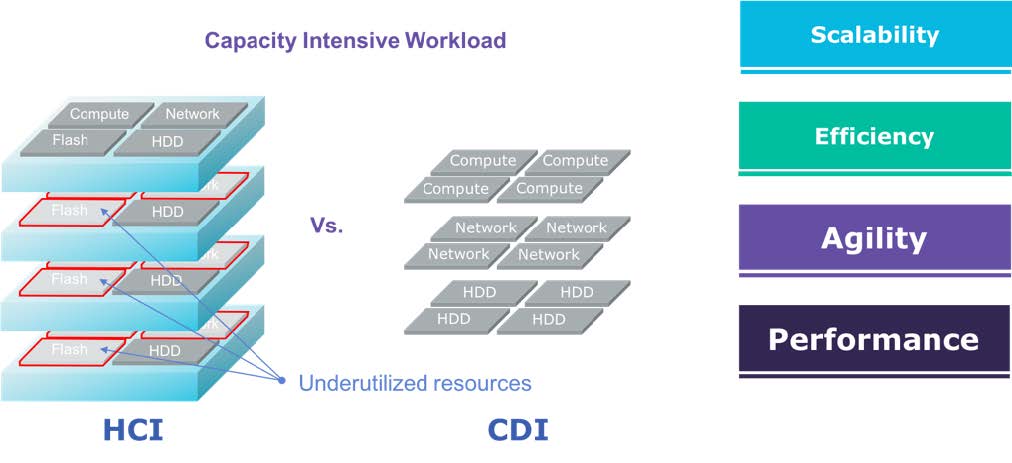
In spite of the fact that hyper-merged foundations (HCIs) join register, stockpiling and system assets into a solitary virtualized framework (Figure 1), to include more stockpiling, memory or systems administration, extra processors are required. This makes a settled building square methodology (each containing CPU, DRAM and storage)that can’t accomplish the dimension of adaptability and unsurprising execution required in the present server farms. In that capacity, Composable-Disaggregated Infrastructures (CDIs) are turning into a prominent arrangement as they go past joining or hyper-meeting IT infrastructure into a solitary coordinated unit, however streamlines them to enhance business readiness.
The Need for Composable-Disaggregated Infrastructures
Given the difficulties related with broadly useful structures (settled asset proportions, underutilization and overprovisioning), met foundations (CIs) rose conveying a preconfigured equipment assets in a solitary framework. The register, stockpiling and systems administration segments are discrete and overseen through programming. CIs have developed into HCIs where the majority of the equipment assets are virtualized, conveying programming characterized figuring, stockpiling and systems administration.
Despite the fact that HCIs join figure, stockpiling and system assets into a solitary virtualized framework, they are not without wasteful aspects. For instance, versatility limits are characterized by the processor, and access to assets are made through the processor. To include more assets, for example, stockpiling, memory, or systems administration, HCI designs gives extra processors regardless of whether they are not required to bring about server farm engineers endeavoring to construct adaptable frameworks yet are utilizing firm building squares.
From an ongoing study of more than 300 moderate sized and vast venture IT clients, just 45 percent of all out accessible capacity limit in an endeavor server farm framework has been provisioned, and just 45 percent of figure hours and capacity limit are used. The settled building square methodology exhibits underutilization and can’t accomplish the dimension of adaptability and unsurprising execution required in the present server farm. The disaggregated HCI show should be empowered and turn out to be effectively composable, of which, programming devices depends on an open application programming interface (API) is what’s to come.
A composable disaggregated foundation is a server farm structural system whose physical register, stockpiling and system texture assets are treated as administrations. The high-thickness figure, stockpiling and system racks use programming to make a virtual application condition that gives whatever assets the application needs continuously to accomplish the ideal execution required to meet the remaining task at hand requests. It is a rising server farm section with a complete market CAGR of 58.2 percent (determined from 2017 to 2022).
Figure 2: Hyper-Converged vs. Composable
On this foundation (Figure 2), virtual servers are made out of free asset pools included process, stockpiling and system gadgets, as opposed to parceled assets that are designed as HCI servers. In this manner, the servers can be provisioned and re-provisioned as required, under programming control, to suit the requests of specific remaining tasks at hand as the product and equipment segments are firmly coordinated. With an API on the creating programming, an application could ask for whatever assets are required, conveying constant server reconfigurations on-the-fly, without human mediation, and a stage toward oneself overseeing server farm.
Hyper-Converged versus Composable
An organized convention is similarly critical to a CDI empowering register and capacity assets to be disaggregated from the server and accessible to different applications. Associating figure or capacity hubs over a texture is vital as it empowers numerous ways to the asset. Developing as the leader organize a convention for CDI usage is NVMe™-over-Fabrics. It conveys the most reduced start to finish dormancy from application to capacity accessible and empowers CDIs to give the information territory advantages of direct-appended capacity (low in activity and elite), while conveying readiness and adaptability by sharing assets all through the endeavor.
Non Volatile Memory Express™ (NVMe) innovation is a streamlined, superior, low idleness interface that uses a design and set of conventions grew explicitly for industrious blaze memory advances. The standard has been stretched out past nearby joined server applications by giving a similar execution benefits over a system through the NVMe-over-Fabrics particular. This determination empowers streak gadgets to convey over systems, conveying a similar elite, low dormancy benefits as nearby appended NVMe, and there is for all intents and purposes no restriction to the quantity of servers that can share NVMe-over-Fabrics stockpiling or the quantity of capacity gadgets that can be shared.
Final Thoughts
Information serious applications in the center and at the edge have surpassed the abilities of customary frameworks and structures, particularly identifying with versatility, execution and productivity. As broader useful frameworks are bolstered by a uniform proportion of assets to address all registers, preparing, stockpiling and system transmission capacity necessities, they are never again viable for these assorted and information serious outstanding burdens. With the coming of CDIs, server farm engineers, cloud specialist organizations, frameworks integrator’s programming characterized capacity designers, and OEMs, would now be able to convey capacity and figure administrations with more noteworthy financial matters, dexterity, productivity and effortlessness at scale, while empowering dynamic SLAs crosswise over outstanding burdens.
Product Ownership is entrenched in programming groups and is urgent to the accomplishment of programming applications; the item proprietor sets the vision, guide and chooses what gets organized. Their activity is to amplify the estimation of the speculation.
Also, their work doesn’t stop when the application goes live. They ensure the administration constantly addresses the issues of its clients after the dispatch.
In any case, it’s an alternate story with regards to IT framework – for things like PCs, printers, systems and WiFi.
Commonly after a huge system roll out, little is done to enhance the system or stay up with the latest. It’s continued ticking over for quite a long time, until the point when it’s well past its utilization by date.
At the Ministry of Justice, we think there is a superior way.
Product ownership for infrastructure – a new paradigm for technology
We’re appointing new product owners roles for our IT infrastructure, starting with end-user computing – i.e. devices and software used by staff.
This item proprietor will continually concentrate on enhancing workers’ figuring background. They will ensure that staff have the correct gadgets, working frameworks and cooperation instruments to carry out their responsibilities.
The item proprietor will be sponsored up by an enduring, cross-utilitarian group, incorporating individuals with conveyance, specialized, business and provider the executives abilities.
This changeless group will have every one of the aptitudes required to convey end-to-end client esteem.
Persistent reestablishment and upgrades
The item proprietor will have the appointed spending plan and the transmit to make ceaseless upgrades.
Little and incessant updates ought to be less unsafe, more affordable and less troublesome than enormous substitution programs that come around once in a blue moon.
We realize that quite a bit of our disappointment request is down to the absence of major and minor overhauls.
A signed up view
Having an item proprietor will enable us to arrange distinctive projects of work, particularly where they have comparable specialized prerequisites.
This should eliminate duplication and cover.
The item proprietor will have a review of projects going on over the association. They’ll organize changes dependent on what’s great esteem and best for our clients.
Single purpose of contact
The item proprietor will be the steady purpose of contact for staff, projects or partners who have thoughts, criticism or solicitations.
This will make it simpler for partners to request gadgets or applications.
It will likewise give the item proprietor a top to bottom comprehension of the business and enable them to battle for upgrades.
Challenges we have faced so far
As this is another method for working we are working through the issues as they emerge.
Every zone can’t work in seclusion. There should be a great deal of collaboration between item proprietors – for example, to guarantee that a demand for video conferencing by the gadget group can be upheld by the system group.
All solicitations must get through the item proprietor for prioritization. This requires all accomplices, for example, acquisition, fund, legitimate and administration sheets to not endorse changes that are gotten outside the item group.
Restricted change limit implies intense prioritization choices. The item proprietor must adjust the requirements of the projects versus the necessities of the client. This can possibly baffle those solicitations are not organized.
Prohibitive contracts can constrain the speed of cycle. Some inheritance provider contracts take into account nonstop cycle and some are increasingly prohibitive. more details : IT infrastructure



 Maintec